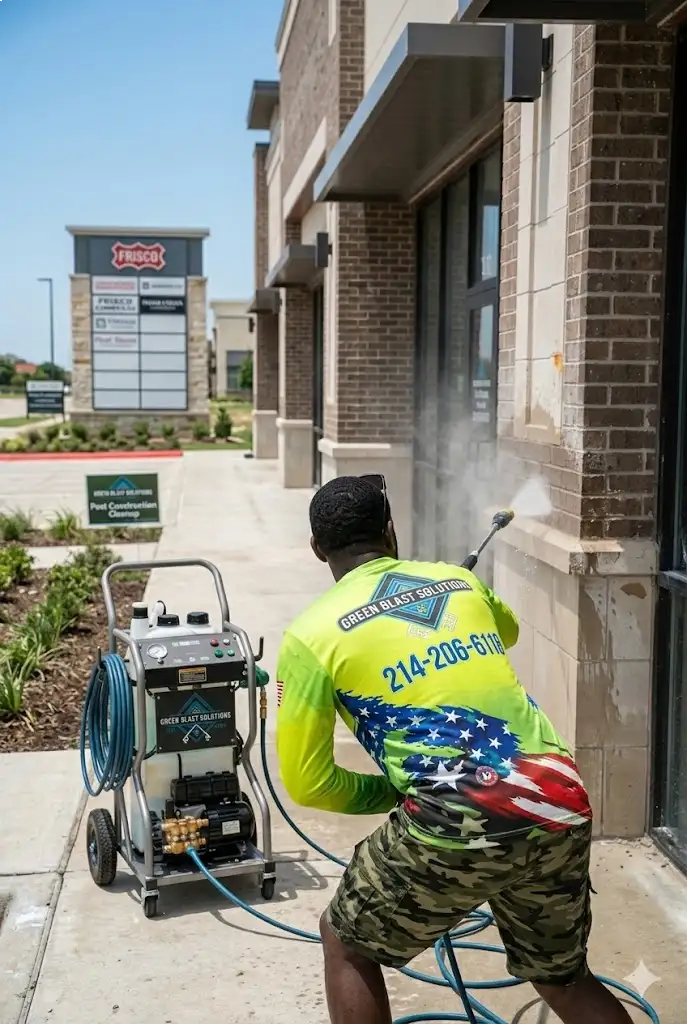
Construction residue doesn’t stay in one place. It settles on glass, bonds to siding, stains concrete, and coats every surface the build crew touched or passed near. By the time a general contractor packs out, a commercial property in Frisco can have construction dust on the facade, calcium and mineral film on every pane, concrete splatter on sidewalks, and grease on loading areas. That’s not one cleaning job. It’s a full exterior reset before the building opens or a tenant moves in.
We handle post-construction exterior cleanup for commercial properties across Frisco and the wider North Texas market. Our scope covers building siding and facades, glass and window systems, concrete flatwork and sidewalks, parking areas, and dumpster pads. We work with churches, storefronts, office buildings, mixed-use properties, apartment complexes, and larger low-rise commercial campuses. We don’t perform suspended rope-access or swing-stage work, and if your building is outside our operating range, we’ll say so before you commit to anything.

Every post-construction project is custom quoted. Pricing is available upon request. Before any number is given, we visit the site, take photos, and gather measurements across every surface in scope. The quote reflects your actual building and actual conditions, not a ballpark that shifts after we arrive.

Several site-specific variables move the price on a post-construction job:

Post-construction cleanup pairs naturally with other exterior services on the same property. Stacking work into a single mobilization reduces cost and gets the building fully reset in one organized visit:
If your building is also due for ongoing facade maintenance or flatwork upkeep, raising that during the site visit can bring down the per-service cost across the whole program.


Post-construction residue requires specific equipment and chemical choices across each surface type. Here’s how each one is handled.

For vinyl siding and brick, we use our soft wash system: rinse, apply a low-pressure cleaning solution, then rinse fully. The chemistry does the work rather than pressure, which helps keep the surface intact. Oxidation on siding is treated with a follow-up application where needed.

Standard windows, double windows, store windows, glass doors, sliders, and both interior and exterior glass are all in scope. Each pane is scrubbed with 0000 steel wool to lift hard water deposits and calcium without scratching, professional window cleaning products are applied, and every surface is rinsed with a low-pressure water-fed pole. Frames, tracks, seals, and screens are cleaned as part of the same pass because dirty frames can re-soil clean glass within weeks if left unaddressed. Screens are cleaned using a screen-cleaning machine, and delicate glass gets hand-washed.
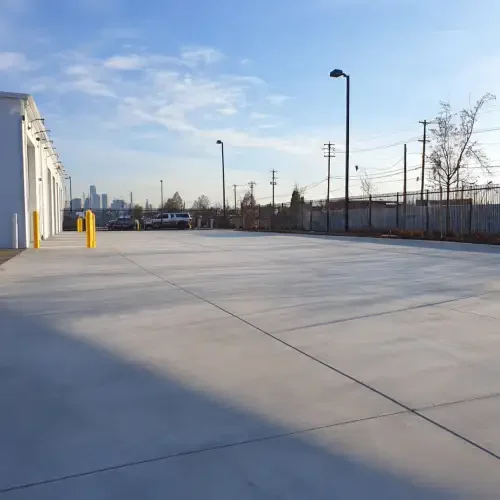
The 10-gallon-per-minute pressure washer with a surface cleaner and commercial-grade specialty treatments handles concrete flatwork, sidewalks, and parking areas. The process is wet, apply, pressure wash, and rinse. Oil staining is treated with professional-grade degreasers and specialty products. Oil can be significantly reduced, but we cannot guarantee full removal on deep staining, and we say that upfront. Severely cracked concrete where the surface cleaner cannot operate safely is the one condition that limits service on a specific area.
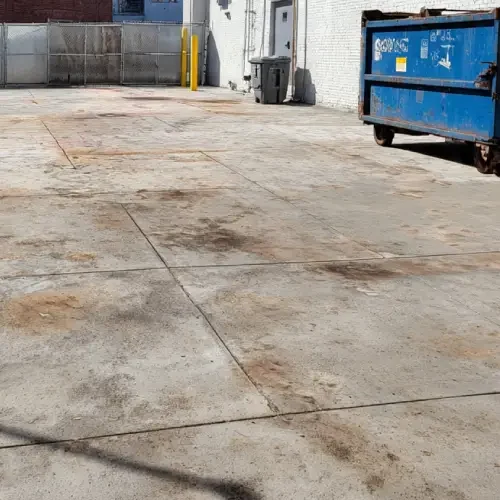
Dumpster pads and loading areas carry grease, organic debris, and compacted grime that standard cleaning won’t cut through. Commercial-grade degreasers are applied alongside the pressure washer, with chemical selection matched to what’s on site. The same apply, dwell, and rinse sequence used on other concrete surfaces applies here.
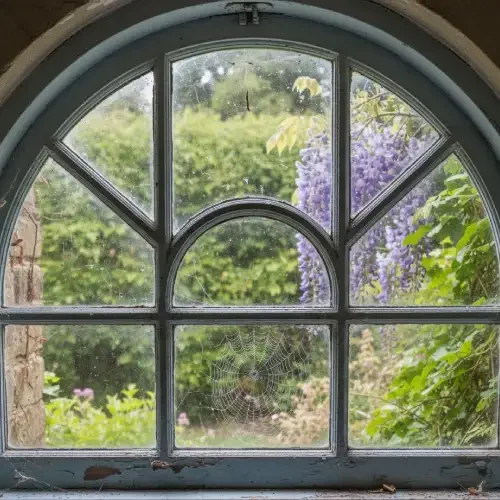
This service does not include antique glass restoration, scratch repair, interior construction debris removal, fixture polishing, or punch-list signoff. Scope is confirmed on the first call and during the site visit, before any work is scheduled.

Every commercial job runs owner-led. There’s no hand-off to a crew you’ve never met. Whoever takes your first call walks the site, scopes the job, and is present during the work. That means consistent communication, honest scoping, and a single accountable contact from first call to closeout.

The equipment reflects the demands of multi-surface commercial work: a 10-gallon-per-minute trailer-mounted pressure washer, a soft wash system for building facades, a long-reach water-fed pole for glass, and a 375-gallon onboard water tank for jobs where connecting to the property water supply is not practical. All chemicals are commercial-grade, sourced from professional pressure washing suppliers rather than retail stores.

Rates don’t shift based on the neighborhood or the perceived size of the job. The quote is tied to actual scope confirmed on site. A property in Prosper gets the same rate structure as one in Frisco.

We run 24/7, which means after-hours access, early-morning starts, and non-peak timing are available for properties that can’t shut down for a cleaning crew. For tenant-occupied buildings, the property manager typically handles occupant notice, but we can communicate directly with residents, provide our contact details, and pause work if someone needs to pass through. High winds or storms affecting exterior work quality may require rescheduling specific sections; we communicate proactively rather than working through conditions that compromise the result.

Low-rise and mid-reach properties are our operating range. True high-rise rope-access and swing-stage work are not offered. We don’t claim formal EPA certifications or specialized water reclamation systems. We’ll tell you what we can and can’t do on the first call, before you’ve committed to anything.








Project timing depends on surfaces in scope, residue level, building access, and whether the property is occupied during service.
Step 1: First Call and Scope Confirmation. We talk through the job, confirm property type, surfaces in scope, access requirements, occupancy status, and turnover timing before anything moves.
Step 2: Site Visit and Quote. We visit the property, walk the full exterior, take photos, and gather measurements across every surface. The quote reflects actual site conditions, not a phone estimate.
Step 3: Coordinate Around Tenants and Traffic. Work is scheduled during non-peak hours or after hours when needed. We can communicate directly with occupants and pause work when someone needs access.
Step 4: Building Exterior and Facade Work. Siding and facades are soft-washed first: rinse, apply surfactant and SH mix, dwell, rinse. Oxidation is treated with a pump sprayer application where needed.
Step 5: Glass and Window System. Each pane is scrubbed, and 0000 steel wool is used to address hard water and calcium before professional window cleaning products are applied and every surface is rinsed with the water-fed pole. Frames, tracks, seals, and screens are cleaned as part of the same process.
Step 6: Concrete Flatwork, Parking Areas, and Dumpster Pads. Commercial-grade cleaning solutions are applied, then pressure-washed off using the 10 GPM machine and surface cleaner. Oil staining is treated with professional-grade degreasers and specialty treatments.
Step 7: Confirm Results and Close Out. Problem areas are addressed before the job closes. Invoicing and follow-up run through Jobber for clean documentation.
Step 8: Set Up Recurring Maintenance. Twice-yearly window service is recommended after the initial glass cleanup. Ongoing exterior maintenance across facades and flatwork can be structured as a recurring program with contract discounts applied from the second visit.
We talk through the job, confirm property type, surfaces in scope, access requirements, occupancy status, and turnover timing before anything moves.
We visit the property, walk the full exterior, take photos, and gather measurements across every surface. The quote reflects actual site conditions, not a phone estimate.
Work is scheduled during non-peak hours or after hours when needed. We can communicate directly with occupants and pause work when someone needs access.
Siding and facades are soft-washed first: rinse, apply surfactant and SH mix, dwell, rinse. Oxidation is treated with a pump sprayer application where needed.
Each pane is scrubbed, and 0000 steel wool is used to address hard water and calcium before professional window cleaning products are applied and every surface is rinsed with the water-fed pole. Frames, tracks, seals, and screens are cleaned as part of the same process.
Commercial-grade cleaning solutions are applied, then pressure-washed off using the 10 GPM machine and surface cleaner. Oil staining is treated with professional-grade degreasers and specialty treatments.
Problem areas are addressed before the job closes. Invoicing and follow-up run through Jobber for clean documentation.
Twice-yearly window service is recommended after the initial glass cleanup. Ongoing exterior maintenance across facades and flatwork can be structured as a recurring program with contract discounts applied from the second visit.


This is specialized exterior cleanup, not a general interior construction janitorial program. Our scope covers building facades, glass and window systems, concrete flatwork, parking areas, and dumpster pads. Interior debris removal, fixture polishing, and punch-list signoff are not included, and we confirm scope clearly on the first call.
Every project is custom quoted after a site visit, photos, and measurements. Pricing is available upon request. Factors that move the number include which surfaces are in scope, their square footage, residue type, building height and access, occupancy, and whether this is a one-time cleanup or the start of a recurring program.
Soft washing. The P40 Comet system applies a low-pressure surfactant and sodium hypochlorite solution that dwells and rinses clean. This keeps pressure off the surface and lets the chemistry do the work. All chemicals used are commercial-grade, not retail.
No. The 0000 grade removes hard water, calcium, and construction residue without scratching the surface. For delicate or older glass, the water-fed pole already runs at very low pressure, and we’ll hand-wash the window if the surface needs extra care.
We use professional-grade degreasers and specialty treatments on oil-affected concrete. These products can significantly reduce or lighten most oil staining, but we cannot guarantee full removal on staining that has penetrated deeply, and we say so before the job starts.
Yes. We run 24/7 and can schedule around non-peak hours, after business hours, or early before operations start. The goal is to work around your schedule, not ask you to restrict access or shut down.
Yes, within the range of our equipment. Larger low-rise commercial properties, including churches and multi-building campuses, can be serviced in sections. True high-rise rope-access work is not part of this service, and we’ll say so on the first call if your building falls outside that range.
For apartment complexes and tenant-occupied buildings, notification is typically coordinated by the property manager. When that’s not practical, we can introduce ourselves to occupants directly, provide our contact details, and pause work if someone needs to pass through.
For glass, twice a year is the practical schedule in North Texas. Active construction across the Frisco market keeps airborne dust circulating, seasonal pollen comes through twice a year, and the local water supply adds hard water deposits to any exposed glass. Clients on a twice-yearly window schedule qualify for 20% off recurring service. For facades and flatwork, maintenance frequency depends on the property’s exposure and use, and we confirm that during the site visit.
For glass, the 30-day spot callback policy applies: if a window comes back spotty, we return and clean it at no charge within 30 days. For other surfaces, raise any concerns on the first call so expectations are set clearly before the job starts.
If you’re managing a commercial property in Frisco or the surrounding North Texas area coming off a build or renovation, call (214) 206-6118 or submit a request. We’ll follow up, walk through the scope, and put together a quote matched to your actual building.